Fort Edmonton Park is Canada’s largest living history museum — a 64-hectare outdoor historical experience on the North Saskatchewan River valley that recreates Edmonton’s development across four distinct historical periods, from the 1846 Hudson’s Bay Company fort through to the 1920 period. It is one of the most ambitious and most complete living history sites in North America, and for first-time visitors from Ontario or British Columbia, the depth of the western Canadian history it presents comes as a genuine surprise.
The park is organized chronologically. The starting point is the reconstructed Fort Edmonton, representing 1846 — a working recreation of the Hudson’s Bay Company trading post on the North Saskatchewan River with costumed interpreters, period activities, and the material culture of the fur trade at its peak. Moving through the park advances through historical time: 1885 Street represents the period of territorial expansion following the North-West Resistance; 1905 Avenue covers the era of Alberta’s provincial status and early settlement; 1920 Boulevard brings the timeline forward to the interwar period, with the first automobiles and changing social structures visible in the architecture and the street life.
The costumed interpreters are the park’s core asset. Fort Edmonton doesn’t simply display artifacts in a static setting — it populates the historical streets with people who are in character as residents, merchants, and workers of the relevant period. Conversations with interpreters reveal specific, personal details about daily life that printed interpretive panels cannot convey, and the experiential quality of walking through an inhabited historical environment is significantly different from a conventional museum visit.
The park underwent a significant facility renewal through the early 2020s, with a new Indigenous Peoples Experience building opening as part of the expansion. This addition presents the history and culture of the Indigenous peoples of the region — including the Cree, Blackfoot, and Métis communities — as an integrated component of the park’s historical narrative rather than an appendage to the European settlement story. The inclusion changes the character of the experience meaningfully.
Practical details that shape a Fort Edmonton visit: the park’s 64 hectares require significant walking, and a complete visit that covers all four historical periods properly takes a full day. A historic streetcar runs between the main entrance and the 1920 Boulevard section, providing both transport and a period-appropriate ride experience. Food options within the park include period-appropriate dining in the historical buildings — eating in a recreation of an 1890s restaurant is part of the experience. An amusement ride area within the park boundaries is specifically aimed at younger children who need occasional activity breaks from the historical content.
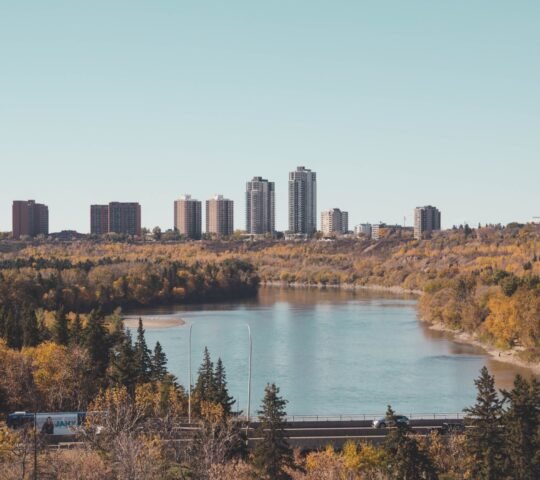
Fort Edmonton Park is located in the North Saskatchewan River valley, accessible from Fox Drive and Whitemud Drive in the southwest of the city. The valley setting is itself significant — the North Saskatchewan River valley is a continuous green corridor through Edmonton and one of the most extensive urban park systems in Canada. The park’s riverside position connects it to the valley trail system for those who want to extend a visit with a walk along the river.
Address: Fox Drive & Whitemud Drive, Edmonton, AB T6J 4X6
Phone: (780) 496-8787
Website: fortedmontonpark.ca
Price: Adults ~$22 · Youth (13–17) ~$16 · Child (3–12) ~$11 · Under 3 free
Hours: Open seasonally — check fortedmontonpark.ca for current hours; typically May through early September
Maps
FAQ's
What historical periods does Fort Edmonton Park cover?
Fort Edmonton Park covers four historical periods: 1846 (the Hudson's Bay Company fur trade era, with a reconstructed fort), 1885 Street (the territorial expansion period), 1905 Avenue (Alberta's early provincial era), and 1920 Boulevard (the interwar period). Moving through the park moves forward through time.
How long does Fort Edmonton Park take to visit?
A complete visit covering all four historical periods with time for interpreter interactions takes a full day — budget 5 to 7 hours. If time is limited, prioritize the 1846 Fort and one of the street periods for a 3-hour visit.
When is Fort Edmonton Park open?
Fort Edmonton Park operates seasonally, typically May through early September. Check fortedmontonpark.ca for current season dates and hours as they vary annually.
Is Fort Edmonton Park good for young children?
Yes — there is an amusement ride area within the park specifically aimed at younger children, alongside the historical content. The costumed interpreters engage children well, and the hands-on activities in many of the historical buildings are designed to work for family visits.
How do I get to Fort Edmonton Park?
Fox Drive and Whitemud Drive in southwest Edmonton. Free parking is available at the park entrance. By transit, check edmonton.ca/transit for current ETS routes serving the Fort Edmonton Park area.